

Public Sector Innovation
Modernize public services faster while keeping IT in control of governance, data, integrations, deployment and long-term application ownership.

Government Modernization
Move faster without bypassing control
Government IT teams are expected to modernize services while operating under strict requirements for security, privacy, procurement, accessibility and continuity.
AI can accelerate application development, but speed creates new risk when governance, integration and ownership are added only after a prototype is built
Betty Blocks puts AI Application Generation inside a governed development environment so public-sector teams can move faster while keeping IT involved from intent to production.
Public Sector
Build faster inside the controls government already needs
Modernize without creating shadow IT
AI can shorten the path from requirement to working software while applications still need to fit existing security, architecture, procurement and release processes.
For projects both in and outside of IT, the approval process is lengthy, with bureaucracy and budget limitations preventing any major development from ever even being considered.
Instead, third-party solutions that only cover 70-80% of a government's needs are implemented as quick wins that only add to monthly costs and cut into already limited budgets.
What Government IT must control
Who can build and change applications
Which data and systems can be accessed
How changes are reviewed and released
How applications remain maintainable and portable
±70% of IT budget is dedicated to maintaining legacy systems
Public-Sector Priorities
What should drive government application modernization?
Competition isn’t exactly a motivating factor for the government sector. Rather, innovation is driven by the demand for more effective systems and processes to improve municipalities, cities, or lifestyles as a whole. Advanced technologies are therefore more focused on bettering experiences and optimizing processes across the board — while driving down costs, of course.
Administrative Efficiency
How Zaanstad modernized youth care while reducing dependency
When the City of Zaanstad needed a new youth care system, no existing package matched its requirements. The team used Betty Blocks to build the application around the municipality’s own process instead of adapting the process to third-party software.
The first version was delivered in 10 days. Zaanstad reports a 40% increase in administrative efficiency, a reduction from 10 backend developers to 4 for maintenance, and seven core applications replaced with Betty Blocks over three years..
The case shows what matters in public-sector modernization: solving a real workflow faster while reducing operational dependency and keeping control of the application landscape.
Development Velocity
80% faster development speed
AI Application Generation
No-Code Innovation
What government teams should expect from an application platform
Government modernization needs more than faster prototyping. The platform should help IT generate, govern, connect and retain control of production applications.
01
Faster path from intent to application
Use AI to turn business requirements into structured application models that teams can review and refine before release.
02
Governance from the start
Use roles, permissions, sandboxing, review controls, status and rollback to keep application delivery inside an explicit operating model.
03
Connect without replacing core systems
Build around existing systems of record through APIs and integrations instead of forcing a full replacement before modernization can begin.
Government IT
AI generation with IT in control
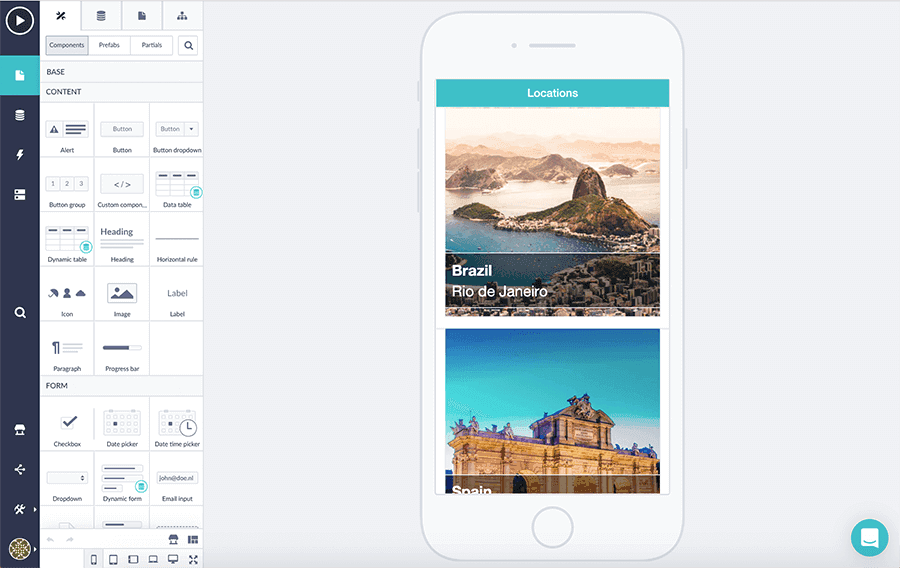
Public-sector teams can use AI to turn domain knowledge into application requirements and working software, while IT retains control over permissions, review, integrations and production release.
Architecture & Ownership
Keep a credible exit path
For government buyers, digital sovereignty is not a vendor nationality claim. It is practical control over data, operations, suppliers, platform dependencies and exit. Betty Blocks positions React and WebAssembly export as a path to application portability beyond the platform.
Digital Sovereignty
Treat sovereignty as an architecture question
Government organizations should evaluate where data is processed, which cloud and AI providers are involved, how applications are governed, what remains supplier-dependent and what happens if platform strategy changes.
Betty Blocks should be assessed against that full architecture. The relevant proof is whether the required governance, integration, deployment and exit conditions can be demonstrated for a real government use case.
Use a real application use case to test governance, integration, ownership and continuity before committing to a platform.